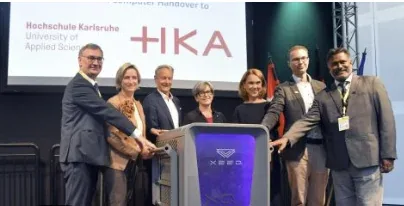
On 6 October 2026, at the Quantum Effects trade fair in Stuttgart, Karlsruhe University of Applied Sciences (HKA) received its new quantum computer from XeedQ. The system was handed over on stage in the presence of Baden-Württemberg’s Minister of Economic Affairs, Dr. Nicole Hoffmeister-Kraut, and Minister of Science, Petra Olschowski, only six months after HKA launched the donation campaign “1,000 Quantenpioniere gesucht” (1,000 quantum pioneers wanted) to fund a quantum computer for its new degree programme.
The handover coincides with the start of the first bachelor’s degree programme in quantum computing in the German-speaking world. Its first cohort of 21 students began their studies the week before and will gain hands-on experience on real quantum hardware from the very beginning.
“Karlsruhe University of Applied Sciences is known for always being one step ahead. As early as 1961, HKA used a Zuse Z22 in its electrical engineering courses, at a time when computers at universities were still the exception. We did not shy away from the risk then, and we are not shying away from it now,” said Prof. Dr. Rose Marie Beck, President of HKA. “Last week, three women and 18 men began their bachelor’s studies in quantum computing. They are not shying away from the risk either, even though the programme is the first of its kind in the German-speaking world and quantum computing is still a research field.”
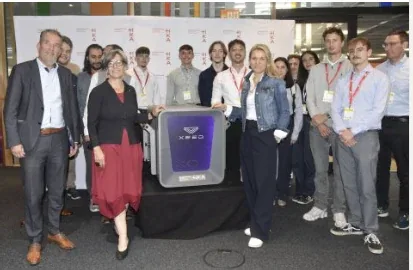
“Technological sovereignty does not come from research results or powerful hardware alone. Above all, it needs well-trained specialists who understand new technologies and can bring them into application,” explained Prof. Dr. Philipp Nenninger, Dean of Studies for Quantum Computing at HKA. “That is exactly where our new programme comes in. Our 21 students will gain application-oriented experience with quantum technologies on our new quantum computer and be prepared for their future work in industry.”
The funding of the system is a special feature of the programme: private individuals, companies, and non-profit associations, HKA’s “quantum pioneers”, raised the full sum within six months. XeedQ joins HKA in thanking everyone who made this milestone possible.
XeedQ’s room-temperature diamond quantum computers are designed for exactly this setting: a compact system that runs without cryogenic infrastructure, can be operated from a classroom or laboratory, and gives students access from Qiskit circuits down to pulse-level control. With this step, HKA also strengthens Baden-Württemberg as one of Europe’s leading locations for quantum technologies.
XeedQ congratulates HKA, its quantum pioneers, and above all the 21 students on the start of their studies, and looks forward to supporting their work on real quantum hardware.
HKA nimmt spendenfinanzierten Quantencomputer entgegen (HKA press release, 6 October 2026, in German)