
How NV computing works
A nitrogen-vacancy (NV) center is a defect in diamond: a nitrogen atom next to a missing carbon atom. Its electron spin and nearby nuclear spins have quantum states that we use as qubits.
Laser light initializes the electron spin, and its fluorescence provides a way to read out the result of a computation. Microwave and radio-frequency pulses control the spins to perform quantum operations.
The nitrogen nucleus and nearby carbon nuclei couple to the electron through hyperfine interactions. Together, these spins form a quantum register. The nuclear spins retain quantum information for much longer than the electron spin.
Available today
XQ1 — 4 qubits One NV center
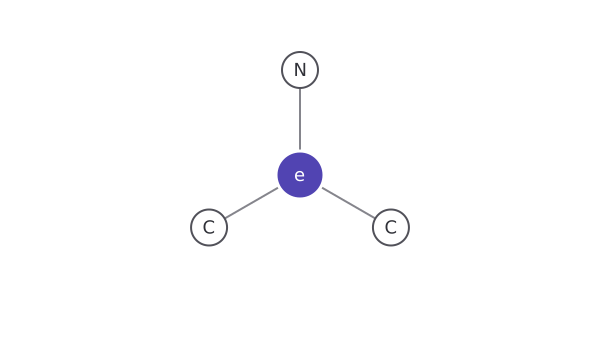
XQ1 is our first-generation device. One NV electron spin couples to its nitrogen nuclear spin and two or more carbon nuclear spins, forming a star-shaped register.
Explore XQ1In production
XQ2 — 8 qubits Two NV centers
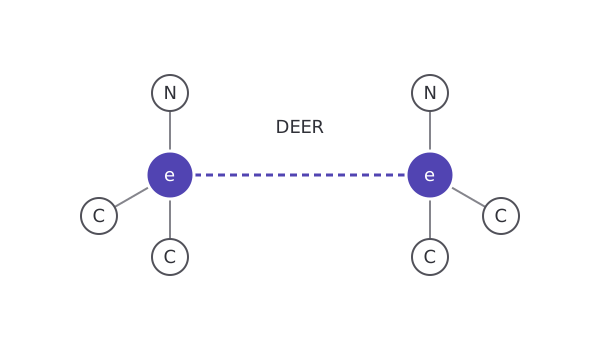
XQ2 is our second-generation quantum computer. It contains two coupled NV centers, each of them coupled to nuclear spins. This forms a tree topology.
Double electron–electron resonance (DEER) pulse sequences control this dipole–dipole electron interaction. The electron spins act as a bus between the longer-lived nuclear qubits.
- Electron spin
- Nuclear spin · N: nitrogen, C: carbon
- Hyperfine interaction
- Electron–electron dipolar interaction
Scaling beyond two registers
Our goal is a larger network of entangled NV registers. When entangled, neighboring electron spins will connect the nuclear spin qubits, offering a Hilbert space that grows exponentially with the number of qubits.

Scaling challenges
Extending this architecture requires precise placement of NV centers and selective control and readout of all qubits.
Fabricating coupled registers
One challenge is to place NV centers approximately 10 nm apart. Their separation determines the strength of the electron–electron dipolar interaction.
Ion-beam implantation offers a route to introducing nitrogen into selected regions of diamond. Subsequent heat treatment allows vacancies to move and form NV centers. Implantation position alone does not guarantee the final position of a usable center: ion scattering, defect formation, and implantation damage all affect the result.
Scaling therefore requires more than a precise pattern. We need reproducible fabrication that preserves spin coherence and stable optical behavior across many registers.
Resolving and addressing individual spins
Strong coupling requirements force NVs close together. Addressing them individually then requires selectivity in both space and frequency.
Spatial resolution: below the diffraction limit
At approximately 10 nm separation, neighboring NV centers lie far below the diffraction-limited resolution of confocal microscopy. A focused laser spot illuminates several centers rather than resolving one. Distinguishing their optical signals and selectively initializing or reading out a register presents an additional challenge beyond placing them nanometers apart.
Spectral resolution: separating spin resonances
Microwave and radio-frequency pulses address transitions between spin states. For frequency-selective control, the spins we want to address independently need sufficiently different resonance frequencies. If resonances overlap, a pulse intended for one qubit can also drive others, causing crosstalk.
The frequency separation must be sufficient relative to the resonance linewidths and the pulse bandwidth. Shorter pulses generally cover a broader frequency range, so faster control can make selectivity more demanding. Scaling requires usable, stable spectral separation as well as close physical spacing.
We are implementing localized magnetic and strain-based methods that could enable site-resolved and frequency-resolved measurements.